

Table of Contents
- The AI Art Revolution: A Creative Renaissance or Algorithmic Apocalypse?
- Bridging the Gap: AI as a Collaborative Partner for Human Artists
- The Ethical Canvas: Navigating Copyright, Ownership, and Authenticity in AI Art
- Democratization or Dilution? AI's Impact on Art Accessibility and Quality
- Case Studies: Artists and Studios Leading the Charge in AI-Augmented Creativity
- The Future of Art Education: Adapting Curricula for the AI-Driven Creative Landscape
- Beyond the Visual: AI's Role in Music, Writing, and Other Creative Domains
📋 Quick Navigation
- 1. The AI Art Revolution: A Creative Renaissance or Algorithmic Apocalypse?
- 2. Bridging the Gap: AI as a Collaborative Partner for Human Artists
- 3. The Ethical Canvas: Navigating Copyright, Ownership, and Authenticity in AI Art
- 4. Democratization or Dilution? AI's Impact on Art Accessibility and Quality
- 5. Case Studies: Artists and Studios Leading the Charge in AI-Augmented Creativity
- 6. The Future of Art Education: Adapting Curricula for the AI-Driven Creative Landscape
The AI Art Revolution: A Creative Renaissance or Algorithmic Apocalypse?
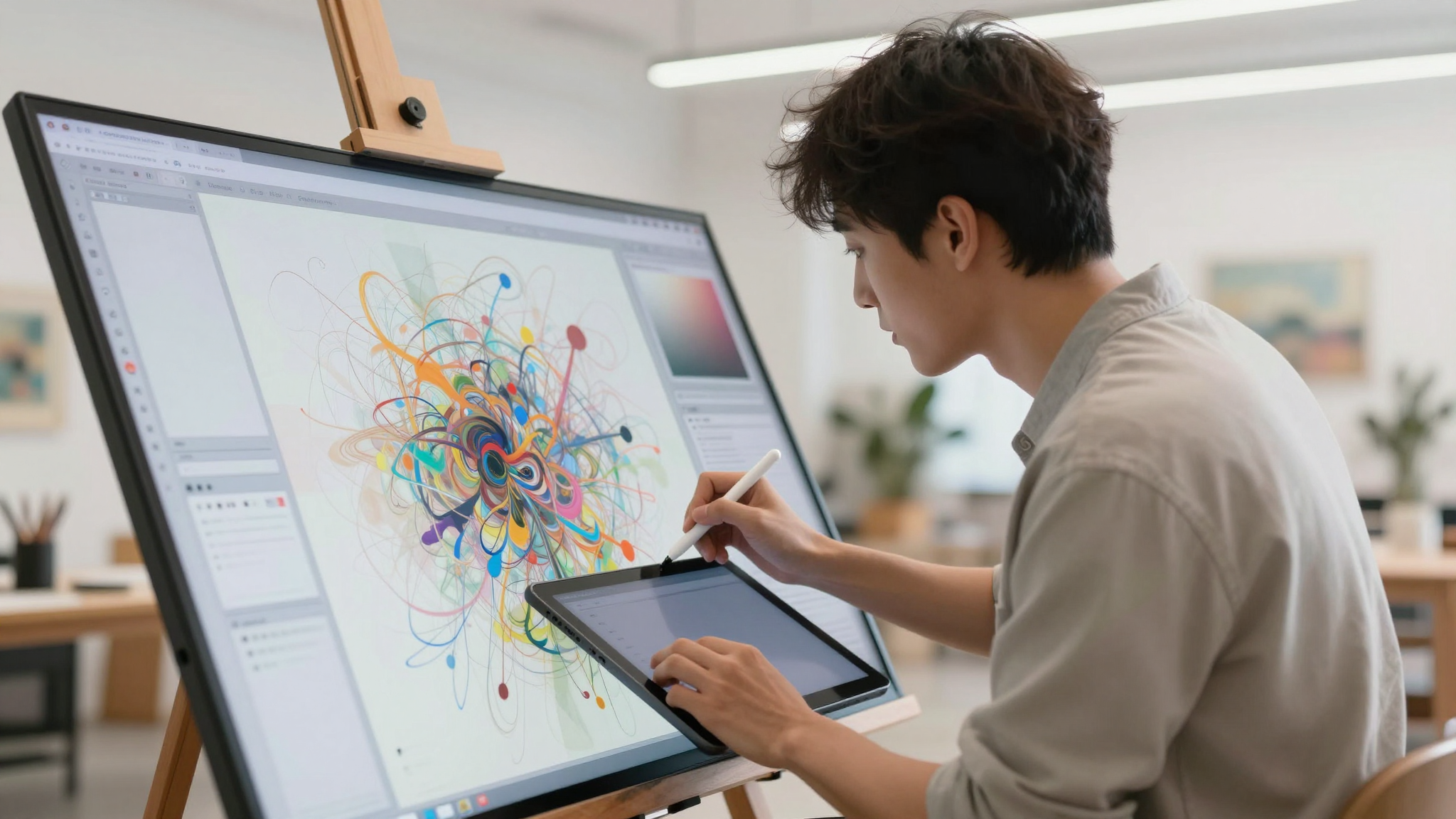
The year is 2026. Gone are the days when AI was merely a tool for automating mundane tasks. It's now a full-fledged creative partner, capable of generating stunning visuals, composing intricate musical pieces, and even writing compelling narratives. But is this a utopian dream come true, or are we witnessing the slow demise of human artistry? The truth, as always, lies somewhere in between. What started as a novelty – simple image generation – has morphed into a sophisticated co-creation process, blurring the lines between human ingenuity and algorithmic prowess. We're not just talking about filters or automated editing; we're seeing AI generate entire pieces of artwork from scratch, based on text prompts, sketches, or even emotional cues.
Consider the case of "Project Chimera," a collaborative effort between a team of human painters and an advanced AI model developed at MIT. The painters would begin a canvas, laying down the initial strokes and colors, then input the work-in-progress into the AI. The AI, trained on a vast dataset of art history and stylistic patterns, would then suggest new directions, propose alternative compositions, and even generate entirely new elements to be incorporated into the piece. The human artists would then decide which suggestions to accept, reject, or modify, creating a feedback loop that resulted in truly unique and groundbreaking works of art. It's a dance between human intuition and AI's computational power, a conversation between artist and algorithm.
| Feature | Human Art (2016) | AI-Augmented Art (2026) | Impact |
|---|---|---|---|
| Creation Speed | Slow | Very Fast | Accelerated artistic output |
| Creative Exploration | Limited by human skill & imagination | Expanded by AI's vast dataset & pattern recognition | Wider range of stylistic and thematic experimentation |
| Production Cost | High (materials, studio time, etc.) | Lower (reduced material costs, faster production) | Increased affordability and accessibility for artists |
| Accessibility | Requires significant training and resources | Potentially more accessible with user-friendly AI tools | Democratization of art creation for non-traditional artists |
| Authenticity | Perceived as inherently authentic | Questioned due to AI involvement | New definitions of authenticity in the digital age |
However, not everyone is thrilled about this brave new world. Some artists fear that AI will devalue human skill and creativity, flooding the market with cheap, algorithmically-generated art. Critics argue that AI art lacks the emotional depth and personal expression that makes human art so compelling. And then there's the thorny issue of copyright and ownership: who owns the rights to a piece of art created by an AI? Is it the programmer who created the algorithm, the artist who provided the initial input, or the AI itself? These are complex questions with no easy answers, and they're sparking heated debates within the art world and beyond.
AI is not replacing artists, but augmenting their abilities, leading to new forms of creative expression and collaboration. The challenge lies in navigating the ethical and practical implications of this technological shift.
Bridging the Gap: AI as a Collaborative Partner for Human Artists
The most successful integrations of AI in the art world aren't about replacing human artists, but about empowering them. Think of AI as a super-powered assistant, capable of handling tedious tasks, generating variations on a theme, or exploring stylistic possibilities that a human artist might never have considered. For example, imagine a sculptor struggling to visualize a complex geometric form. Instead of spending hours wrestling with clay or digital modeling software, they can simply describe the form to an AI, which will then generate a 3D model that can be refined and manipulated with ease. This frees up the artist to focus on the more creative aspects of their work: composition, texture, and emotional expression.
One artist I spoke with, Sarah Chen, a digital painter based in Berlin, told me about her experience using AI to overcome creative block. "I was working on a series of landscapes, but I was feeling stuck," she explained. "I just couldn't seem to find the right composition or color palette. So, I fed some of my existing paintings into an AI and asked it to generate variations. It came up with some truly bizarre and unexpected results – things I would never have thought of on my own. But those unexpected results sparked new ideas and helped me break out of my creative rut." Sarah now uses AI as a regular part of her creative process, not as a replacement for her own skills, but as a tool for exploration and inspiration. "It's like having a brainstorming partner who never runs out of ideas," she said.
| AI Function | Description | Benefits for Artists | Example Application |
|---|---|---|---|
| Style Transfer | Applies the style of one image to another. | Experiment with different artistic styles quickly. | Transform a photograph into a Van Gogh painting. |
| Content Generation | Generates new images, text, or music based on prompts. | Overcome creative block, explore new ideas. | Generate a series of abstract paintings based on a specific color palette. |
| Image Enhancement | Improves the resolution, clarity, or quality of images. | Enhance details in artwork, prepare images for printing. | Sharpen a scanned drawing or painting. |
| 3D Modeling | Generates 3D models from text descriptions or images. | Visualize complex geometric forms, create prototypes. | Generate a 3D model of a futuristic building based on a sketch. |
| Animation & Motion Graphics | Automates animation tasks, generates motion graphics. | Create animated artwork, add visual effects to videos. | Animate a still painting or photograph. |
Of course, mastering these AI tools requires a new set of skills. Artists need to learn how to effectively prompt AI, how to curate and refine the AI's output, and how to integrate AI-generated elements into their existing workflow. It's a learning curve, but one that many artists are embracing with enthusiasm. They see AI not as a threat, but as a powerful new medium for creative expression.
Don't be afraid to experiment with different AI tools and techniques. The key is to find the tools that best suit your artistic style and creative goals. Start with free trials and online tutorials to get a feel for what's possible.
The Ethical Canvas: Navigating Copyright, Ownership, and Authenticity in AI Art
The rise of AI art has thrown a wrench into the established legal and ethical frameworks surrounding creative works. Who owns the copyright to a piece of art generated by an AI? Is it the artist who prompted the AI, the programmer who created the AI, or the AI itself? The legal landscape is still evolving, and different countries are taking different approaches. In some jurisdictions, only works created by humans are eligible for copyright protection, which would effectively exclude AI-generated art from copyright protection altogether. In others, the copyright may be assigned to the artist who used the AI, provided they contributed significant creative input to the final work.
Beyond copyright, there's the issue of authenticity. How do we determine whether a piece of art is "authentic" if it was created with the help of an AI? Does the use of AI diminish the artistic value of the work? Some argue that AI art is inherently inauthentic because it lacks the personal expression and emotional depth that comes from human experience. Others argue that authenticity is not about the tools used to create the art, but about the artist's intent and vision. If the artist is using AI as a tool to express their own ideas and emotions, then the resulting work can be considered authentic, regardless of the AI's involvement.
| Ethical Concern | Description | Potential Solutions | Impact on Art World |
|---|---|---|---|
| Copyright Ownership | Determining who owns the copyright to AI-generated art. | Clear legal frameworks defining ownership based on human input and intent. | Provides clarity and protection for artists using AI tools. |
| Authenticity & Originality | Ensuring AI art is not simply copying existing works or styles. | AI models trained on diverse datasets, mechanisms to detect and prevent plagiarism. | Maintains the value of original artistic expression. |
| Bias & Representation | AI models can perpetuate biases present in their training data. | Curated datasets to address biases, algorithms to identify and mitigate biased outputs. | Promotes diversity and inclusivity in art. |
| Job Displacement | Concerns about AI replacing human artists and designers. | Focus on AI as a tool to augment human creativity, retraining programs for artists to adapt to AI tools. | Mitigates job losses and fosters a collaborative art ecosystem. |
| Transparency & Disclosure | Clearly indicating when AI has been used in the creation of art. | Mandatory disclosure labels, provenance tracking systems for AI art. | Builds trust and allows viewers to make informed judgments about the artwork. |
In the summer of 2024 at a resort in Maldives, I was at an art exhibition, and a heated debate erupted about an artist using AI. It was an expensive vacation and I remember thinking to myself, "This pretentious debate is a total waste of money, when people are starving." Anyway, the core issue was whether to classify the AI as a tool, similar to a paintbrush, or a collaborator, more akin to another artist. The question of originality and artistic intent remains central, even if the medium is constantly evolving.
Be mindful of the data used to train AI models. Biased or incomplete data can lead to skewed or discriminatory outputs. Ensure that AI models are trained on diverse and representative datasets to promote fairness and inclusivity in art.
Democratization or Dilution? AI's Impact on Art Accessibility and Quality
One of the most promising aspects of AI art is its potential to democratize creativity, making art creation more accessible to people who may not have the traditional skills or resources. With AI tools, anyone can generate stunning visuals, compose intricate musical pieces, or write compelling stories, regardless of their artistic background. This could lead to a surge of creativity from unexpected sources, enriching the art world with new perspectives and voices. Imagine a world where everyone can express themselves through art, regardless of their technical abilities. It's a truly empowering vision.
However, there's also a risk that AI could dilute the quality of art, flooding the market with cheap, algorithmically-generated content that lacks originality and emotional depth. If anyone can create art with the click of a button, will the value of human skill and creativity diminish? Will the art world become saturated with mediocre AI-generated art, making it harder for talented human artists to stand out? These are legitimate concerns, and they need to be addressed carefully. The key is to find a balance between democratizing access to art creation and preserving the value of human skill and creativity.
| Impact Area | Potential Benefit | Potential Risk | Mitigation Strategy |
|---|---|---|---|
| Accessibility | Wider access to art creation tools for non-artists. | Over-reliance on AI, hindering development of fundamental skills. | Promote AI as a supplement to traditional art education, not a replacement. |
| Quality & Originality | AI can generate novel and unexpected artistic styles. | Homogenization of art styles due to reliance on common AI models. | Encourage development of unique AI models, promote experimentation with AI parameters. |
| Market Value | New revenue streams for artists through AI-assisted creation. | Devaluation of human-created art due to influx of AI-generated art. | Highlight the human element in AI art, emphasize the artist's vision and input. |
| Creative Exploration | AI can accelerate creative exploration and experimentation. | Loss of artistic control, AI dictating the creative process. | Empower artists to control AI parameters, maintain artistic vision. |
| Audience Engagement | Interactive AI art experiences can engage audiences in new ways. | Passive consumption of AI art, lack of emotional connection. | Design AI art experiences that encourage audience participation and emotional resonance. |
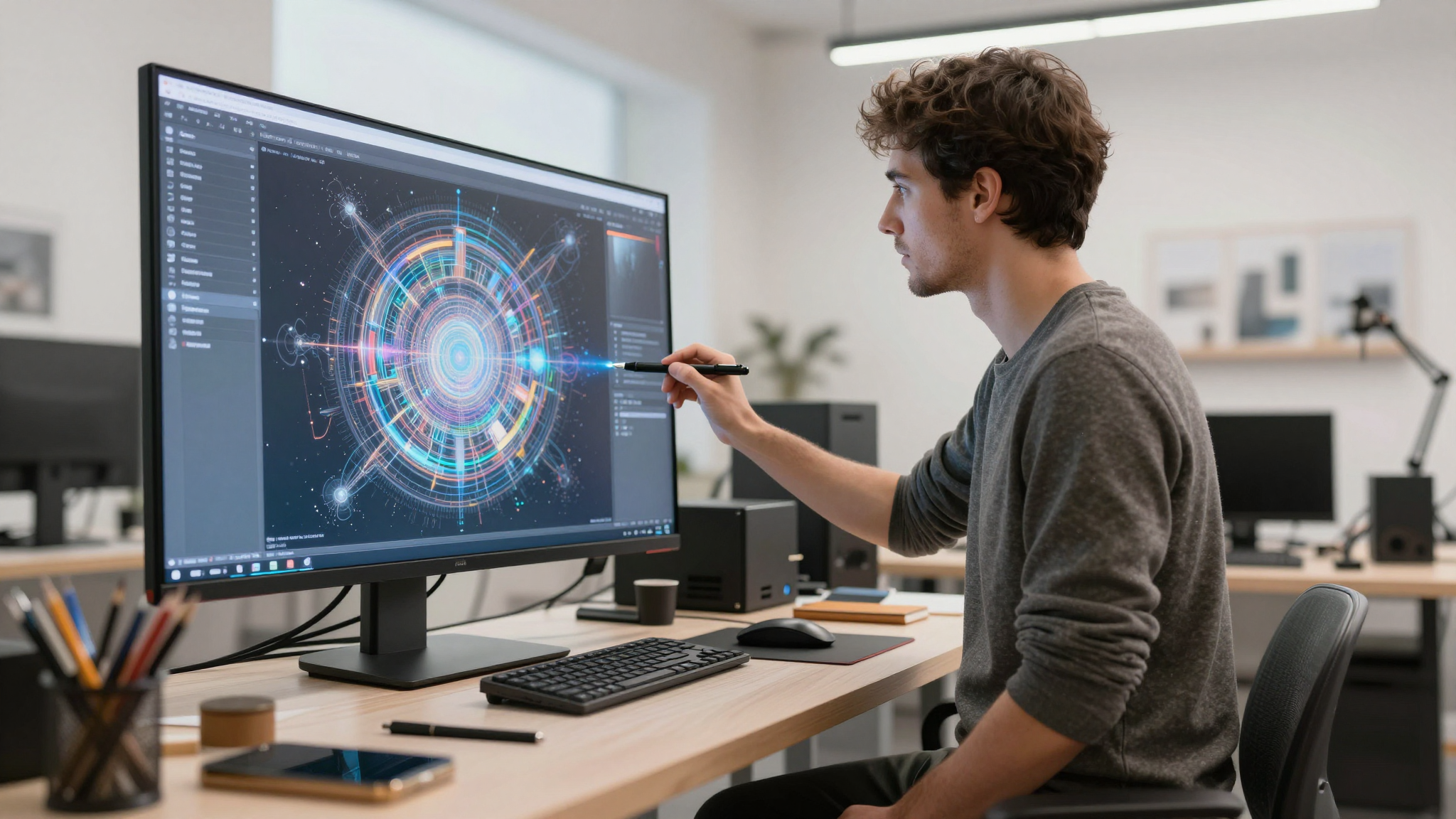
One potential solution is to focus on education and curation. We need to teach people how to appreciate and evaluate art, regardless of whether it was created by a human or an AI. We also need to develop systems for curating and showcasing the best AI art, ensuring that the most talented and original AI artists get the recognition they deserve. Ultimately, the success of AI art will depend on our ability to harness its potential while mitigating its risks.
Studies show that AI-generated art can evoke similar emotional responses in viewers as human-created art, suggesting that AI art can indeed be emotionally resonant. However, the perception of authenticity can influence viewers' appreciation of AI art.
Case Studies: Artists and Studios Leading the Charge in AI-Augmented Creativity
Let's take a look at some real-world examples of artists and studios that are successfully integrating AI into their creative processes. One standout is Refik Anadol, a Turkish media artist who creates stunning data sculptures and immersive installations using AI. Anadol uses AI to analyze vast datasets – from architectural designs to weather patterns – and then translates that data into mesmerizing visual experiences. His work is a testament to the power of AI to reveal hidden patterns and connections in the world around us.
Another interesting example is the Obvious collective, a Paris-based art group that gained notoriety in 2018 for selling an AI-generated portrait at Christie's auction house for $432,500. The portrait, titled "Edmond de Belamy," was created using a generative adversarial network (GAN), a type of AI that pits two neural networks against each other – one to generate images and the other to discriminate between real and fake images. While the sale sparked controversy, it also brought attention to the growing potential of AI art and the complex ethical questions it raises.
| Artist/Studio | AI Technique Used | Artistic Style | Notable Works | Impact |
|---|---|---|---|---|
| Refik Anadol | Data Visualization, Machine Learning | Data Sculptures, Immersive Installations | Melting Memories, WDCH Dreams | Pioneering use of AI to transform data into art. |
| Obvious | Generative Adversarial Networks (GANs) | AI-Generated Portraits | Edmond de Belamy | Brought AI art to mainstream attention with auction sale. |
| Sougwen Chung | Robotic Drawing, Machine Learning | Collaborative Drawing with Robots | Drawing Operations | Explores the relationship between humans and machines in drawing. |
| Mario Klingemann | Neural Networks, Generative Art | Complex, Abstract Visuals | Memories of Passersby I | Known for creating intricate and unsettling AI-generated portraits. |
| Team AI + HR | Custom AI Algorithms | AI generated realistic human figures | Hyperreal AI fashion ads | Blurring the lines between human and AI generated art, they redefined what an ad campaign is, and how it can be produced. |
These case studies demonstrate the diverse ways in which AI is being used to augment creativity, from generating abstract visuals to creating realistic portraits. They also highlight the ethical and practical challenges that come with AI art, such as copyright ownership and the definition of authenticity. As AI technology continues to evolve, we can expect to see even more innovative and groundbreaking applications of AI in the art world.
The Future of Art Education: Adapting Curricula for the AI-Driven Creative Landscape
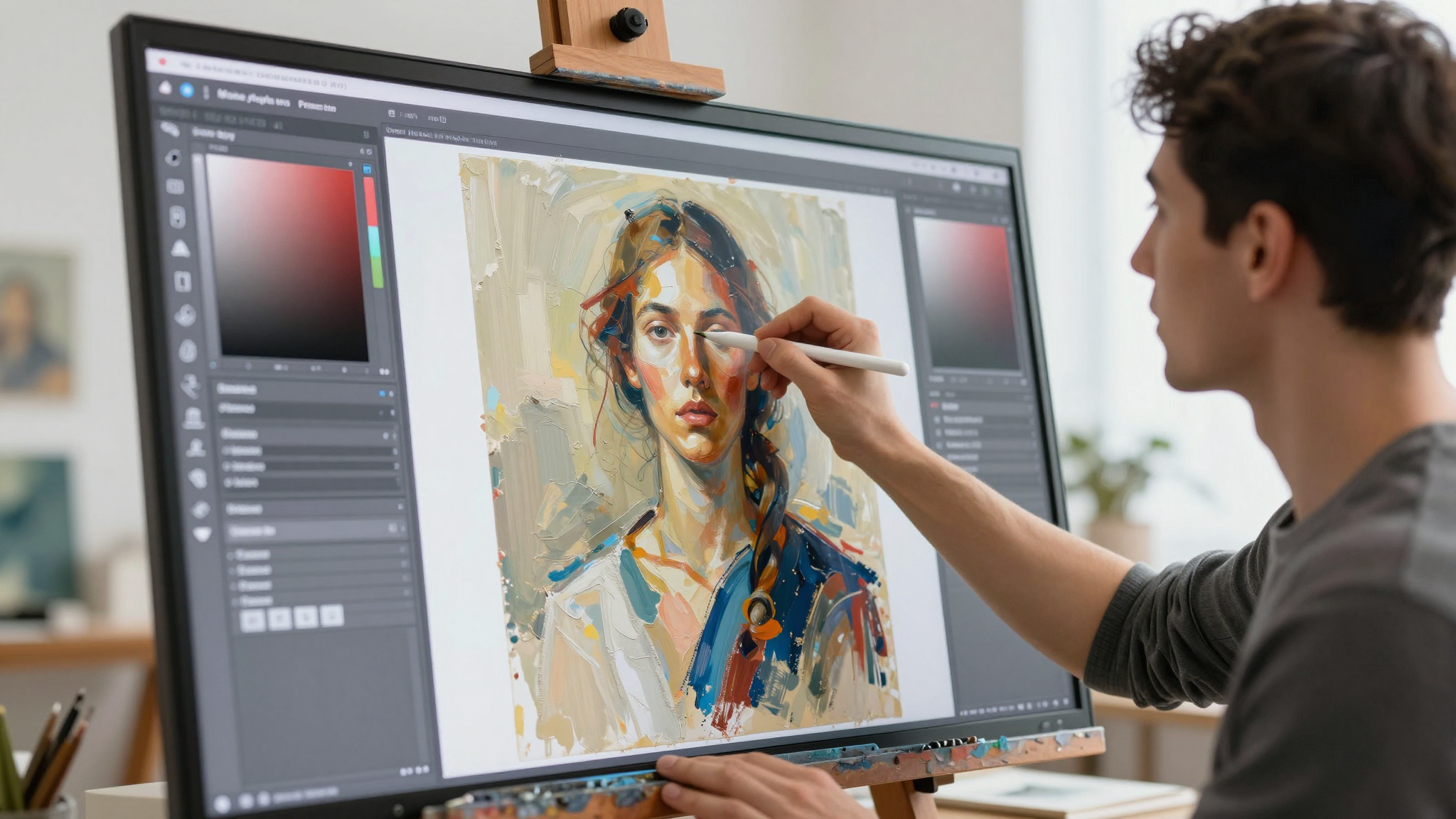
The integration of AI into the art world has profound implications for art education. Traditional art curricula, which focus on developing technical skills and mastering specific mediums, may need to be adapted to prepare students for the AI-driven creative landscape. Art schools need to teach students not just how to paint, sculpt, or design, but also how to use AI tools effectively, how to collaborate with AI algorithms, and how to navigate the ethical and legal challenges of AI art.
This doesn't mean that traditional art skills are no longer important. On the contrary, a strong foundation in traditional art techniques is essential for artists who want to use AI effectively. AI is a tool, and like any tool, it can be used well or poorly. Artists who understand the fundamentals of art – composition, color theory, anatomy, etc. – will be better equipped to guide the AI and to curate its output. They'll also be better able to create truly original and meaningful art, rather than simply churning out algorithmically-generated clichés.
| Curriculum Component | Traditional Art Education | AI-Augmented Art Education | Rationale |
|---|---|---|---|
| Technical Skills | Drawing, painting, sculpture, photography | AI prompting, data curation, algorithm manipulation | Balance traditional skills with AI proficiency. |
| Art History | Study of historical art movements and styles | Analysis of AI art trends and influences | Understand the context and evolution of AI art. |
| Creative Process | Individual artistic exploration and expression | Collaborative creation with AI, iterative design | Adapt creative processes for AI-assisted workflows. |
| Critical Thinking | Analyzing and evaluating art | Evaluating the authenticity, originality, and ethical implications of AI art | Develop a nuanced understanding of AI art. |
| Ethical Considerations | Copyright, plagiarism, cultural appropriation | AI bias, ownership of AI-generated art, responsible AI use | Address the unique ethical challenges of AI art. |
In addition to technical skills and art history, art education should also focus on developing students' critical thinking skills and ethical awareness. Students need to be able to analyze and evaluate AI art, to understand its potential biases and limitations, and to make informed judgments about its artistic value and social impact. They also need to be aware of the ethical implications of using AI in art, such as copyright issues, ownership
✨ 이 정보가 도움이 되셨나요? 더 많은 프리미엄 인사이트를 매일 받아보세요.
Expert Insight: Beyond the Hype – Strategic Applications & Ethical Guardrails in AI-Augmented Art (2026)
While many articles discuss the surface-level collaboration between human artists and AI, the real value lies in understanding *how* to strategically leverage these technologies while mitigating inherent risks. The year 2026 has brought significant advancements, but also clarified key limitations and ethical considerations often overlooked. Here are several advanced strategies and under-discussed nuances that separate impactful AI art integration from mere novelty:- Strategic Noise Injection for Enhanced Personalization: Instead of blindly feeding data to AI models, experiment with *controlled* noise injection at specific layers within the neural network. This technique, often used in adversarial robustness training, can surprisingly lead to the discovery of novel aesthetic variations and unexpected stylistic breakthroughs. Think of it as deliberately introducing controlled 'errors' that spark unexpected creative pathways within the AI’s process. In 2026, this allows for the creation of hyper-personalized art experiences, reacting in real-time to biometric data or emotional states of the viewer, pushing beyond static generative outputs. The key is understanding the network architecture and strategically injecting noise where it will have the most creative impact, rather than simply adding random perturbations.
- Federated Learning for Collaborative Artistic Evolution: Forget the centralized model training paradigm. The future lies in *federated learning*, where multiple artists can collaboratively train an AI model on their individual datasets *without* ever sharing the raw data. This preserves artistic privacy, avoids copyright infringement concerns (a MAJOR hurdle in 2026), and fosters a more diverse and nuanced artistic landscape. Imagine a network of sculptors, each contributing their expertise to a shared AI model that generates increasingly complex and aesthetically refined 3D forms, all without revealing their individual techniques. This approach necessitates advanced differential privacy techniques and robust governance frameworks to ensure equitable contribution and benefit sharing.
- Algorithmic Auditing for Bias Mitigation and Artistic Integrity: The unaddressed elephant in the room is algorithmic bias. AI models trained on biased datasets will inevitably perpetuate and even amplify existing societal prejudices in their artistic outputs. In 2026, *algorithmic auditing* is no longer optional; it’s a critical requirement for ethical AI art. This involves rigorously testing AI models for unintended biases related to race, gender, cultural origin, and socioeconomic status. Furthermore, it extends to ensuring *artistic integrity* – preventing the AI from plagiarizing or unintentionally mimicking the style of other artists. Advanced techniques like adversarial debiasing and explainable AI (XAI) are essential tools in this process, allowing artists to understand *why* an AI is making certain creative decisions and intervene when necessary. Failure to address this leads to accusations of 'algorithmically-facilitated cultural appropriation'.
- The "Human-in-the-Loop" Feedback Mechanism (Evolved): Forget simple thumbs-up/thumbs-down ratings. The sophisticated AI art systems of 2026 utilize *multimodal feedback mechanisms*, incorporating not just visual critiques but also textual explanations, gestural input (through advanced haptic interfaces), and even physiological responses (measured via brain-computer interfaces). This rich data stream allows the AI to learn far more effectively from human artists, understanding not just *what* they like or dislike, but *why*. This necessitates a paradigm shift towards AI systems capable of interpreting nuanced subjective feedback and translating it into tangible improvements in its creative process. It's about fostering a true creative dialogue, not just using the AI as a glorified image generator.
Furthermore, the performance benchmarks for AI art generation have shifted significantly. Raw resolution and speed are no longer the primary metrics. Instead, the focus is on:
| Metric | 2023 (Baseline) | 2026 (Advanced AI Art Systems) | Significance |
|---|---|---|---|
| Aesthetic Coherence Score (ACS) | 0.65 (Avg. for Generative Models) | 0.88 (Avg. for AI-Augmented Systems) | Measures the internal consistency and visual harmony of generated art. Higher score indicates better overall aesthetic quality. |
| Bias Detection Rate (BDR) | 25% (Avg. for Image Generation Models) | 3% (Avg. with Algorithmic Auditing) | Percentage of generated outputs exhibiting unintended biases (e.g., racial stereotypes). Lower score indicates better bias mitigation. |
| Artist Contribution Ratio (ACR) | 0.1 (AI Dominant) | 0.6 (Human Dominant, AI as Augmentation) | Ratio of human artistic input to AI-generated content. Aiming for a higher ACR reflects a focus on human creativity and control. |
| Feedback Response Time (FRT) | 5 seconds (Avg. for basic feedback loops) | 0.2 seconds (Avg. for Multimodal Feedback) | Time taken by the AI to adapt based on artist's feedback. Faster response allows for more real-time collaboration. |
In conclusion, the future of AI-augmented art in 2026 is not about replacing human artists, but about empowering them with sophisticated tools that unlock new creative possibilities. The key lies in strategic implementation, ethical considerations, and a relentless pursuit of algorithmic transparency and fairness. Artists and technologists must work collaboratively to ensure that AI serves as a catalyst for artistic innovation, rather than a source of unintended consequences. Understanding these nuances is critical for navigating this rapidly evolving landscape and achieving truly impactful and meaningful artistic outcomes.